

Dual fuel / Ontario
Keep the furnace or rip it out? The honest version
A dual fuel system runs whichever fuel is cheaper hour by hour. Whether that is worth it turns on one number most quotes never mention.
- Licensed contractor
- GTA and Southern Ontario
- Verified 18 Jul 2026
Aire One Heating & Cooling is a licensed heating, cooling and indoor air quality contractor serving the Greater Toronto Area and Southern Ontario, in business since 1990. Call 310-4328.

Short answer. A dual fuel or hybrid system pairs an air-source heat pump with a gas furnace and switches between them at a set outdoor temperature. Natural Resources Canada endorses the pairing, calls it a good option when replacing a central air conditioner, and states the important limit: the two cannot run at the same time, so either the heat pump runs or the furnace runs. The switch point that decides your bill is the economic balance point, the temperature where gas becomes cheaper per unit of heat than the heat pump, and it moves with Ontario energy prices. As of the Ontario Energy Board rates effective 1 November 2025, off-peak electricity is 9.8 cents per kWh and on-peak is 20.3 cents, which is exactly why the switch point is not a fixed number anyone can promise you in advance. For how a heat pump itself works and what the rebates pay, see our heat pump guide.
On this page
What dual fuel actually is
If your furnace still has years left and someone is telling you to tear it out for a heat pump, dual fuel is the option that usually gets skipped in that conversation. It is worth understanding before you spend money either way.
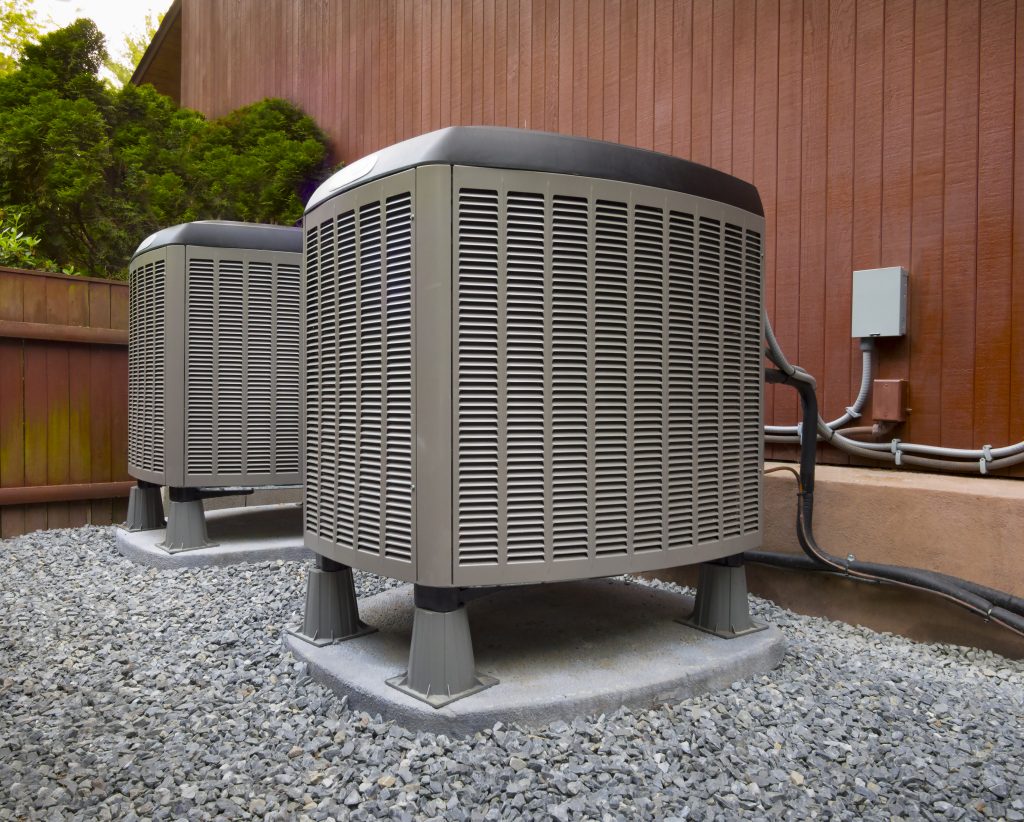
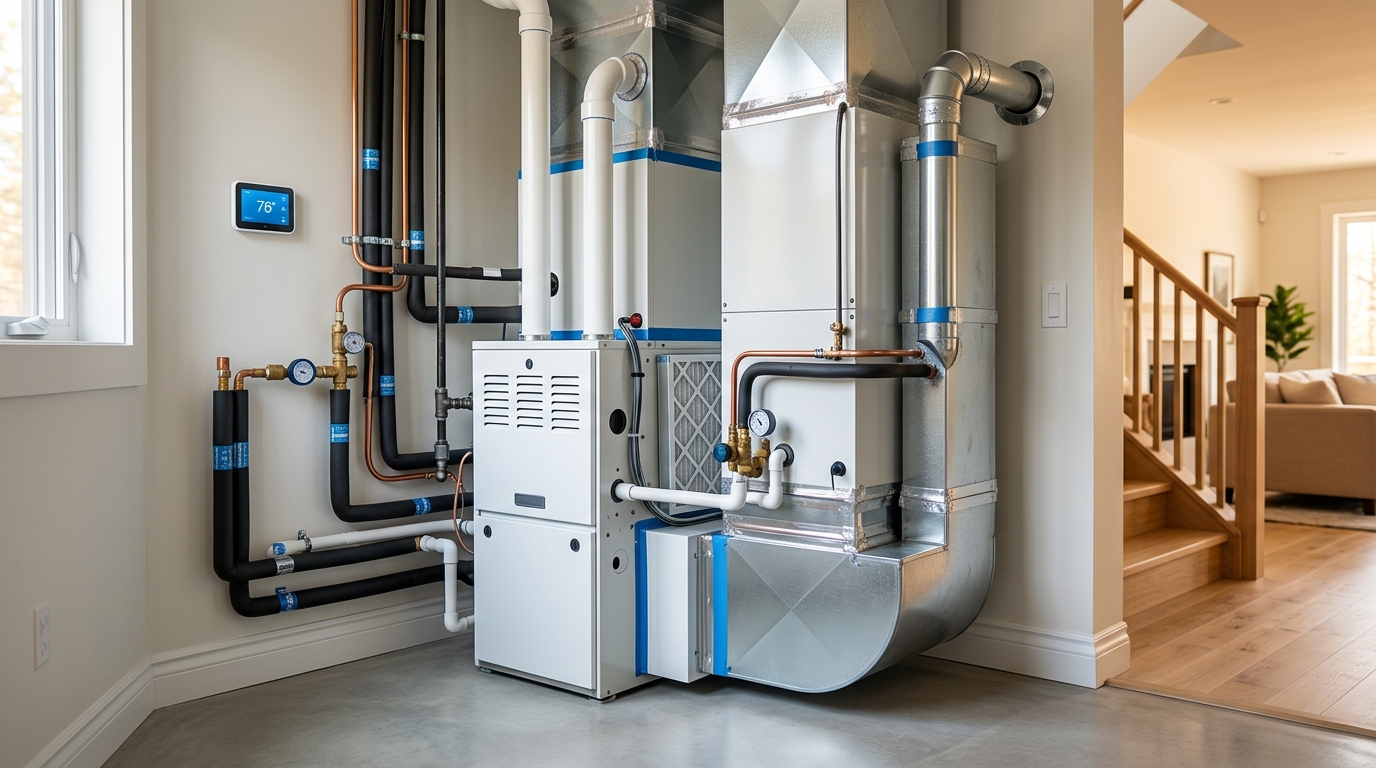
A dual fuel system is one heat pump and one furnace, wired to a control that picks between them based on the outdoor temperature. Above a set point, the heat pump does the heating, quietly and efficiently. Below it, the control locks out the heat pump and hands the job to the gas furnace, which produces high-output heat regardless of how cold it is outside. You keep cooling in summer from the same heat pump. NRCan describes exactly this arrangement, a heat pump using a supplemental furnace or boiler, and specifically names it a good option where a heat pump is added to an existing system, for example as a replacement for a central air conditioner.
The single most important mechanical fact, straight from NRCan, is one the sales pitch tends to blur: a hybrid system cannot run both at once. Either the heat pump operates or the gas furnace operates. This is different from an all-electric setup, where resistance backup can run at the same time as the heat pump. It matters because it means dual fuel is a clean handoff, not a blend, and the entire question is where that handoff should happen.
The part that is genuinely appealing. If you already have gas service and ductwork, which describes most GTA homes, you are adding a heat pump to infrastructure you already own rather than rebuilding the house around electric heat. You also sidestep the heat pump's weakest moment. As we cover in our heat pump guide, an air-source unit's efficiency falls as it gets colder, with NRCan putting its COP at 1.1 to 3.7 at -8C. Dual fuel simply stops using the heat pump before it reaches the part of that range where it is barely better than electric resistance.
The three balance points, and the one that matters
Every dual fuel decision comes down to a switchover temperature, and there are three different temperatures that could set it. Getting these straight is the whole game, because a contractor who conflates them is guessing with your money.
| Point | What it is | Set by |
|---|---|---|
| Thermal balance point | The temperature where the heat pump's capacity equals your home's heat loss | Your home and the equipment. Below it, the heat pump physically cannot keep up |
| Economic balance point | The temperature where gas becomes cheaper per unit of heat than the heat pump | Energy prices. This one moves, and it is usually the right one to switch on |
| Cut-off temperature | The heat pump's minimum operating temperature, below which it stops entirely | The manufacturer. A hard floor, not a preference |
NRCan defines all three and notes that the outdoor sensor is usually set to shut the heat pump off at the economic balance point, the outdoor temperature below which it is cheaper to heat with the supplementary system. That is the key insight and it is why dual fuel can beat both a furnace alone and a heat pump alone: the system is always running whichever fuel costs less at that moment.
Here is the arithmetic, because it is real and you can sanity-check any quote against it. The economic balance point is where the cost per unit of heat from the heat pump equals the cost from the furnace. The Consortium for Energy Efficiency publishes the switchover formula contractors use: the heat pump's required COP at crossover equals your electricity rate in dollars per kWh, times 29.31 kWh per therm, times the furnace's AFUE efficiency, divided by the gas rate in dollars per therm. You then read off the manufacturer's COP-versus-temperature curve to find which outdoor temperature gives that COP. That temperature is your economic switch point.
Why no honest contractor gives you one fixed switchover number. Look at that formula: your electricity rate and your gas rate are both inside it. When either price changes, the correct switch point moves. NRCan makes the same point in plain language, noting the sensor is set to the economic balance point, which is a price-dependent quantity, not a fixed property of the equipment. A good dual fuel control lets you adjust the switchover as prices shift. If gas gets expensive, you lower the switch point so the heat pump does more. If gas gets cheap, you raise it so the furnace does more.
Why Ontario prices decide the answer
The reason dual fuel is a live question in Ontario specifically, rather than a settled one, is that our electricity is priced in a way that changes the maths through the day and through the year.
Off-peak electricity per kWh, OEB, from 1 Nov 2025
On-peak electricity per kWh, same OEB schedule
The on-peak to off-peak spread you are switching against
Under the Ontario Energy Board's Regulated Price Plan rates effective 1 November 2025, Time-of-Use electricity is 9.8 cents per kWh off-peak, 15.7 cents mid-peak and 20.3 cents on-peak. The Tiered option is 12.0 cents per kWh up to the winter threshold and 14.2 cents above it. The province also raised the Ontario Electricity Rebate to 23.5 percent effective the same date, which reduces the bill a typical household pays. These are the OEB's published supply rates, in effect through 31 October 2026.
Two things follow for a dual fuel owner. First, because the heat pump runs on electricity that more than doubles in price from off-peak to on-peak, the economic switch point genuinely differs depending on when the heat is called for, which is why a smart control earns its place here. Second, and this is the honest caveat that most heat pump marketing omits, when electricity is expensive relative to gas, the economic balance point rises and the furnace does more of the work. That is not dual fuel failing. That is dual fuel doing exactly its job: protecting you from paying heat-pump-on-peak prices when gas is cheaper.
What this means before you sign. Ask your contractor to compute your economic balance point using the current OEB electricity rate for your plan and your actual gas rate, not a rule of thumb and not a number from a US calculator. The rates above are the OEB's as of 18 July 2026 and they reset on 1 May and 1 November each year. Gas prices change too. Any switchover number is a snapshot, and the value of a dual fuel system is that the snapshot can be re-taken whenever prices move.
Who dual fuel is right for, and who it is not
We install heat pumps, furnaces and dual fuel systems, so we have no reason to push you toward one over another. Here is the honest sorting.
Dual fuel tends to make sense when several of these are true.
- You already have gas service and ductwork. You are adding a heat pump to existing infrastructure rather than rebuilding around electric heat.
- Your furnace still has life in it. Pairing a new heat pump with a furnace that has years left keeps that asset working instead of scrapping it. If the furnace is already near end of life, the calculation changes.
- You want cooling anyway. The heat pump is your air conditioner in summer, so you are buying one machine for two jobs.
- You want insulation from price swings. With both fuels available, you are never fully exposed to a spike in either electricity or gas.
Dual fuel is the wrong answer, or at least not obviously the right one, when these hold instead.
- You heat with oil, propane or electric baseboards, not gas. Then the comparison is a heat pump against an expensive incumbent fuel, and a heat pump alone, or with electric backup, is often the stronger and simpler play. NRCan notes heat pump savings are largest exactly when replacing electric or oil heat.
- You have no gas line. Adding gas service to enable a furnace backup is a large cost that usually kills the case for dual fuel versus a cold climate heat pump with electric backup.
- You are chasing the largest rebate and the deepest carbon cut. A dual fuel system still burns gas on cold days. It reduces emissions less than going all-electric, and depending on program terms it may qualify differently. Check the rebate against your actual configuration.
- Simplicity matters more to you than the last few percent of savings. Two heat sources is two things to maintain. That is a real, if modest, tradeoff.
The one step that is not optional either way. NRCan is explicit that heating and cooling loads should be determined by a professional using a recognised method, CSA F280-12, not a rule of thumb. This is not upselling. An oversized heat pump cycles and wastes money in mild weather; an undersized one leans on the backup and never delivers the savings you were promised. The load calculation is what tells you whether your home can run on a heat pump alone or genuinely benefits from the furnace backup. Skipping it is the most common reason a system underperforms.
The savings claims, weighed
You will see dual fuel advertised as cutting heating costs by 30 to 50 percent. We want to be precise about what that number is and is not.
That range comes from HVAC industry sources, not from a government study, and it is a comparison against heating with gas alone. It is directionally plausible: for much of a GTA heating season the outdoor temperature sits in the range where a heat pump's COP is well above 1, so moving heat is cheaper than burning gas, and a dual fuel system captures that while still calling on gas for the coldest stretch. But the actual figure for your house depends on the same variables that set your economic balance point: your electricity rate, your gas rate, your home's heat loss, and how many hours the season spends on each side of the switchover. We are not going to attach a percentage to your specific home, because anyone who does without running your numbers is quoting a brochure.
What we can say with primary-source backing is narrower and more useful. NRCan confirms the mechanism: a heat pump moves more heat energy than the electricity it consumes whenever its COP exceeds 1, and its COP is above 1 across most of the temperature range Ontario sees. The OEB confirms the prices that make the switchover a live calculation rather than a fixed setting. Put together, dual fuel is a sound strategy for a gas-heated GTA home with a serviceable furnace. The size of the win is real but specific to your bills, and it is smaller in a year when electricity is expensive relative to gas.
On the environmental claim, the same honesty applies. A dual fuel system burns less gas than a furnace alone, so it cuts emissions, but it burns more than an all-electric heat pump, so the carbon reduction is partial. If your priority is the deepest possible carbon cut and your home and budget can support it, all-electric goes further. If your priority is the best operating cost in Ontario's price environment with dependable heat on the coldest nights, dual fuel is often the stronger choice. Those are different goals, and a contractor should ask which one is yours before recommending either.
Questions homeowners ask
What temperature does a dual fuel system switch to the furnace?
There is no single correct number, because the right switch point is the economic balance point and that depends on prices. NRCan defines it as the outdoor temperature below which it is cheaper to heat with the supplementary system, and notes the outdoor sensor is usually set to it. The Consortium for Energy Efficiency's formula makes the dependency explicit: the crossover depends on your electricity rate and your gas rate. Under the Ontario Energy Board rates from 1 November 2025, electricity runs 9.8 cents per kWh off-peak to 20.3 cents on-peak, so the switch point genuinely moves through the day. Ask your contractor to calculate it from your actual rates rather than quoting a fixed figure.
Can a heat pump and furnace run at the same time in a dual fuel system?
No. NRCan is explicit that a hybrid system cannot run both simultaneously: either the heat pump operates or the gas furnace operates. The control locks out one and enables the other based on the outdoor temperature. This is different from an all-electric setup, where resistance backup can run alongside the heat pump. In a dual fuel system the handoff is clean, which is why the entire design question is where the switchover temperature should sit.
Is dual fuel cheaper than a heat pump alone in Ontario?
Often, for a gas-heated home, and the reason is Ontario's electricity pricing. A heat pump's efficiency falls as it gets colder, with NRCan putting its COP at 1.1 to 3.7 at -8C, and Ontario Energy Board on-peak electricity is 20.3 cents per kWh as of 1 November 2025. Below the economic balance point, gas delivers heat more cheaply, so a dual fuel system that switches to the furnace there avoids the heat pump's most expensive operating conditions. A heat pump alone, using electric resistance backup, runs that backup at full electricity prices on the coldest days. Whether the gas backup wins depends on your specific rates, which is why a load and cost assessment matters.
Do I need dual fuel if I have a cold climate heat pump?
Not necessarily, and this is a real decision rather than a default. A cold climate heat pump holds efficiency to lower temperatures and pushes its cut-off temperature down, so it needs backup less often. But it still has a cut-off, and in Ontario's on-peak electricity pricing there can still be a temperature where gas is cheaper per unit of heat even while the heat pump is capable of running. So the question is not only can the heat pump keep up, but is it cheaper to run than gas right now. For a home with gas already connected, dual fuel answers both. For a home without gas, a cold climate heat pump with electric backup is usually simpler and avoids the cost of a new gas line.
Will a dual fuel system still burn gas, and does that hurt the environment?
Yes, it burns gas on the coldest days, and that is the honest tradeoff. A dual fuel system cuts emissions compared with a furnace alone, because the heat pump handles most of the season, but it cuts them less than an all-electric heat pump that never burns gas. If the deepest carbon reduction is your goal and your home and budget support it, all-electric goes further. If your goal is the lowest operating cost in Ontario's price environment with reliable heat in a deep cold snap, dual fuel is often the stronger option. They optimise for different things, so the right answer depends on which you are prioritising.
Do not take our word for it. Every number above comes from a source you can check yourself. Ask an AI to verify this page against the primary sources:
Matthew Arbab
Managing Director, Aire One Heating & Cooling. Aire One has served Ontario homeowners since 1990 and its technicians design heating systems, including dual fuel setups, across the GTA and Southern Ontario. This article was written to be checkable: every figure is traced to a primary source with the date it was read, and where a savings claim comes from industry rather than a study, it says so.
Want your economic balance point calculated, not guessed?
We will run your heat loss and your actual electricity and gas rates, then tell you whether dual fuel, a heat pump alone, or a furnace is the right call for your home. Serving the GTA and Southern Ontario since 1990.
Sources, all verified 18 July 2026. Natural Resources Canada, Heating and Cooling With a Heat Pump (cited for: the hybrid arrangement of a heat pump with a supplemental furnace or boiler, named a good option when replacing a central air conditioner; hybrid systems being unable to run simultaneously with the heat pump while all-electric backups can; the thermal balance point, economic balance point and cut-off temperature definitions; the outdoor sensor usually set to shut the heat pump off at the economic balance point; air-source COP of 1.1 to 3.7 at -8C; heat pump savings being largest when replacing electric or oil heat; loads determined by a professional using CSA F280-12; over and undersizing outcomes). Ontario Energy Board, Changes to Electricity Prices, effective 1 November 2025 (cited for: Time-of-Use rates of 9.8 cents per kWh off-peak, 15.7 mid-peak and 20.3 on-peak; Tiered rates of 12.0 and 14.2 cents per kWh; the Ontario Electricity Rebate rising to 23.5 percent; rates in effect through 31 October 2026 and reset on 1 May and 1 November). Consortium for Energy Efficiency, Controls for a Heat Pump with Secondary Heating (cited for: the economic switchover formula relating the crossover COP to electricity rate, therms per kWh, furnace AFUE and gas rate, and the method of reading the switch temperature off the manufacturer's COP curve). The 30 to 50 percent heating-cost-saving figure is an HVAC industry estimate for dual fuel versus gas alone, not a government-verified number, and actual savings depend on your electricity and gas rates, home heat loss and switchover setting.
Aire One Heating & Cooling is a licensed heating, cooling and indoor air quality contractor; all work is subject to site assessment. Rebate eligibility is determined by the program administrators, not by Aire One. Energy prices and program terms change without notice; the figures above were verified 18 July 2026 and should be confirmed on the day you decide. Terms and conditions apply. This article is general information, not a quote and not an offer.