
Do You Need an HRV? An Ontario Homeowner's Guide (2026)
How a heat recovery ventilator works, what it costs in Canadian dollars, where the Ontario Building Code stands, and the homes that honestly do not need one.
By Ben Amina, Owner and Manager
Aire One East Heating & Cooling, Whitby, Ontario
Technical review: [INSERT REVIEWER NAME + REAL ROLE OR TSSA LICENCE CLASS, Aire One East]
An HRV in Ontario solves a problem most homeowners create on purpose. You sealed the draughts, upgraded the windows, and topped up the insulation, and your heating bill dropped. The same airtightness that saved you money also stopped your house from exchanging air on its own, so moisture, cooking particles, and carbon dioxide now stay put. This guide explains what a heat recovery ventilator actually does, what it costs in Ontario, when it is the right fix, and when it is not. It sits under our indoor air quality guide for Durham Region homes.
Aire One East is a Carrier Factory Authorized contractor in Whitby, family owned and serving Durham Region since 1991, with licensed technicians, 4.8 stars from 364 Google reviews, 24 hour emergency service, protection plans, and financing. To find out whether your home needs ventilation or something cheaper, call 905-576-7600 or book a free in home assessment.
How an HRV Actually Works
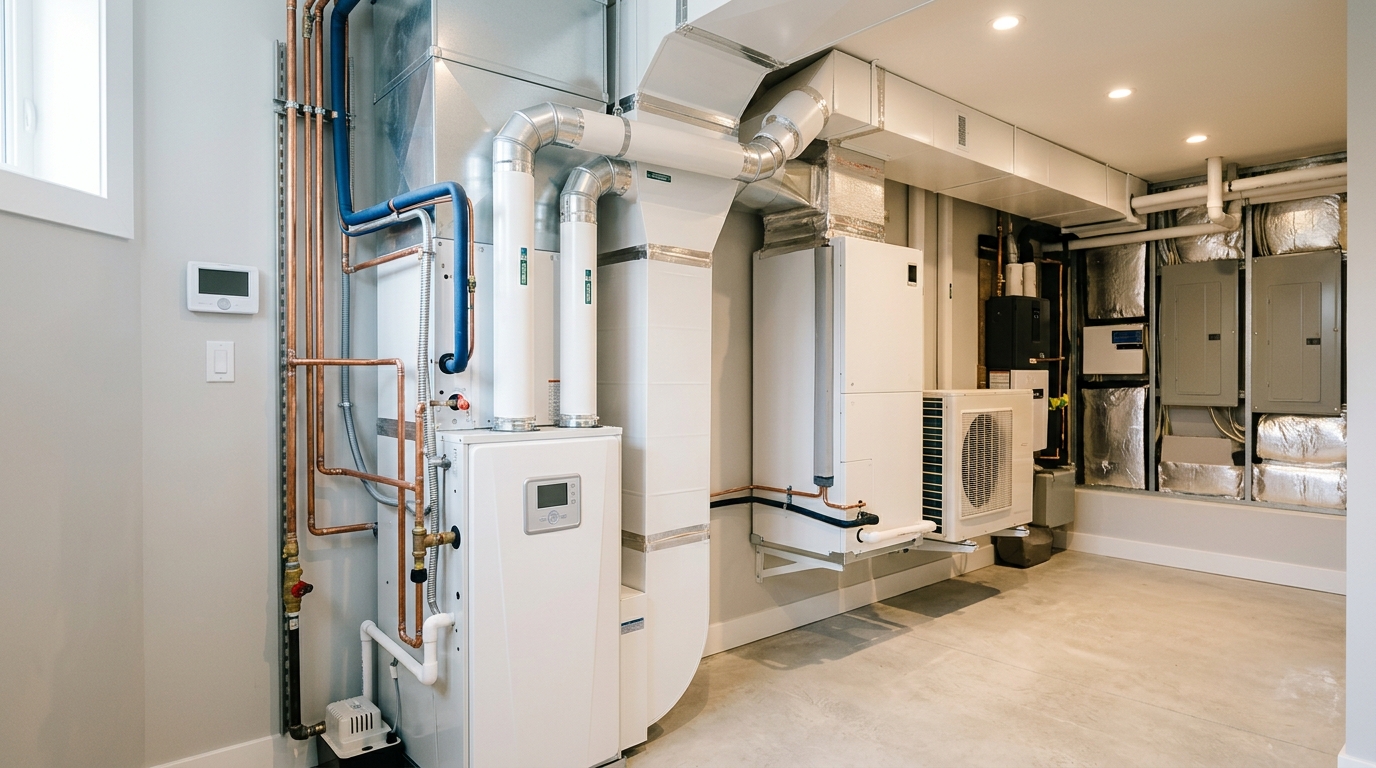
A heat recovery ventilator is a small, dedicated appliance, usually mounted near the furnace, with two ducted air streams running through it. One pulls stale air out of the house from the areas that generate the most moisture and odour, typically bathrooms, the laundry area, and the kitchen zone. The other pulls fresh outdoor air in and distributes it to living areas and bedrooms.
Between them sits a heat exchange core. In winter, the warm outgoing air gives up most of its heat to the cold incoming air as they pass through separate channels. The two streams never mix, so you are not recirculating anything, but the energy transfers across. The result is fresh air that arrives already tempered, which means your furnace is not starting from -15 degrees every time the ventilator runs. In summer the effect works in reverse and takes some of the edge off incoming warm air.
The efficiency measure to look at is sensible recovery efficiency, or SRE, rated at -25 degrees Celsius. Under the 2024 Ontario Building Code, units in new homes must reach at least 55 percent SRE at that temperature, rising to 65 percent on enhanced efficiency compliance paths. Better residential units published in the 70 to 80 percent range at milder outdoor temperatures, which is where the widely quoted "up to 80 percent" figure comes from. It is a real number, but it is a best case at mild conditions, not what the unit delivers in a Whitby January.
HRV or ERV, Which Suits an Ontario Home
The two look identical and get confused constantly. An HRV transfers heat only. An ERV, or energy recovery ventilator, transfers heat and a portion of the moisture, which changes how it behaves in each season.
| Factor | HRV | ERV |
|---|---|---|
| Transfers | Heat only | Heat and some moisture |
| Ontario winter effect | Removes excess indoor humidity, good for fogging windows | Retains some indoor humidity, less drying |
| Ontario summer effect | Brings humid outdoor air in as is | Sends part of incoming humidity back out, easing the cooling load |
| Best for | Homes with condensation, damp basements, high winter humidity | Homes that already run dry in winter, or struggle with summer humidity |
| Condensate drain | Usually required | Often not required |
| Typical installed cost (CAD) | $2,500 to $4,200 CAD | $2,800 to $4,500 CAD |
Costs shown are typical Ontario ranges in Canadian dollars (CAD), verified July 2026, subject to change. Exact pricing requires an in home assessment.
For most Durham Region homes the deciding factor is what your windows do in January. If they fog and drip, you have surplus indoor moisture and an HRV is the better match because it carries that moisture out. If your home already runs so dry that you need a humidifier every winter, an ERV holds more of that moisture in and works with you rather than against you.
Do You Need an HRV in Your Durham Home?
Fair first, because this is where the industry oversells. An HRV is the most expensive item on the indoor air quality list, and plenty of Durham homes do not need one. If your house was built before roughly the mid 1990s, has not been air sealed, and you can feel a draught at the windows on a windy day, it is already exchanging air continuously. Adding mechanical ventilation to a leaky envelope mostly adds cost.
Here is the honest test. An HRV is likely worth it if two or more of these are true in your home:
- Windows fog or drip on the inside during cold weather, especially in bedrooms overnight.
- The house was built after about 2010, or has had a full air sealing and window retrofit.
- Cooking odours linger for hours and the place smells stale within an hour of shutting the windows.
- Someone in the house has allergies or asthma that are worse indoors than outdoors.
- The bathroom stays damp long after a shower, or you are seeing recurring mould at window frames or in the basement.
- You feel headachy or drowsy in a closed room, which points to carbon dioxide accumulation rather than particles.
When this is not the right call: if none of the above apply, or if your only complaint is dust, an HRV is the wrong purchase. Dust is a filtration problem, and moving from a basic filter to MERV 11 to 13 costs a fraction of the price. Our furnace filter guide covers that. If your only complaint is dry winter air, that is a humidifier, not a ventilator. We would rather tell you that on the phone than sell you the wrong appliance.
What an HRV Costs in Ontario
HRV pricing is quote based because the ducting is the variable, not the box. A home with accessible mechanical space and existing duct runs sits at the low end. A finished basement where new supply runs have to reach bedrooms sits at the high end.
| Item | Typical Ontario Range (CAD) | What Drives the Price |
|---|---|---|
| HRV unit only | $800 to $2,500 CAD | Airflow capacity, SRE rating, controls, brand |
| Retrofit install, straightforward | $2,500 to $3,500 CAD | Accessible mechanical room, short duct runs, simple exterior penetrations |
| Retrofit install, complex | $3,500 to $4,200 CAD | Finished basement, new supply runs to bedrooms, longer ducting |
| Additional ductwork if required | $35 to $55 CAD per linear foot | Home layout, access, number of rooms served |
| Operating cost | About $3 to $10 CAD per month | Roughly 30 to 90 watts on low speed, plus your electricity rate |
| Annual service and core cleaning | $0 DIY to $200 CAD per visit | Filters and core are homeowner cleanable, balancing is not |
Costs shown are typical Ontario ranges in Canadian dollars (CAD), verified July 2026, subject to change. Exact pricing requires an in home assessment.
The operating cost is the number that surprises people in a good way. A continuously running ventilator sounds expensive until you see that it draws about as much as a couple of light bulbs, and the heat recovery is what keeps it from showing up on the gas bill. The upfront install is the real cost, which is why financing and our protection plans exist.
What the Ontario Building Code Requires
This matters if you are building, buying new, or renovating substantially. The 2024 Ontario Building Code came into force on 1 January 2025, and from 1 April 2025 every new residential permit application in Ontario must comply with it. Section 9.32 now makes mechanical ventilation with heat or energy recovery part of the assumed ventilation strategy for new homes, so an HRV or ERV is no longer an optional upgrade on a new build.
The permit package must include a Mechanical Ventilation Design Summary prepared to CAN/CSA-F326, naming the selected unit and its certified SRE at -25 degrees Celsius. Kitchens require principal exhaust of at least 100 CFM and each bathroom at least 50 CFM. If your home has more than five bedrooms, the simplified Section 9.32 path does not apply and a full CSA F326 design is required.
None of this applies retroactively to an existing Whitby or Oshawa home. If you bought a house built in the last few years, though, it very likely already has an HRV sitting near the furnace, and in our experience a good number of homeowners do not know it is there or have never cleaned the filters. That is worth checking before you spend anything.
Rebates in 2026, the Honest Picture
Two programs Ontario homeowners still ask about are finished. The Canada Greener Homes Grant is closed, and Enbridge Gas closed intake to the Home Efficiency Rebate Plus program in February 2024, with final documentation deadlines passing at the end of 2025. Any contractor still advertising those for an HRV is quoting an expired program.
The live provincial program is Home Renovation Savings, delivered by Enbridge Gas and Save on Energy with support from the Government of Ontario, which launched on 28 January 2025. As of July 2026, its published measure list covers heat pumps, insulation, windows and doors, air sealing, smart thermostats, solar, battery storage, and heat pump water heaters. A standalone heat recovery ventilator is not on that list. Where an HRV can matter is indirectly: air sealing is a rebated measure, and tightening a house is exactly what creates the need for mechanical ventilation, so the two are often planned together.
[VERIFY REBATE: confirm current Home Renovation Savings eligible measures and amounts at homerenovationsavings.ca on the day of publish, and update this section if HRV or ERV is added. Do not publish a rebate figure that has not been checked.]
Installation, Balancing, and Upkeep
An HRV is one of the few pieces of home equipment where a bad installation actively makes air quality worse rather than merely disappointing. The unit has to be balanced so the supply and exhaust airflows match. If exhaust exceeds supply, the house goes negative, which can pull air backwards down a chimney or flue, and that is a combustion safety issue, not a comfort one. This is why commissioning and airflow measurement at the end of the job are not optional extras.
The upkeep, by contrast, is genuinely easy and mostly yours to do:
- Filters: vacuum or rinse every three months, more often with pets.
- Core: pull and clean once or twice a year following the manufacturer's instructions.
- Exterior hoods: check twice a year for leaves, nests, and winter ice buildup.
- Condensate drain: confirm it is clear each heating season on an HRV.
- Airflow balance: have it verified professionally if you have renovated, changed ducting, or added equipment.
[INSERT AIRE ONE EAST DATA: e.g. the share of Durham Region homes with an existing HRV where our technicians found the filters or core had never been cleaned, with the number of homes (N), the date window, and the technician or team who compiled it. Publish only with a real sample of at least 30 and show the N beside any percentage. Delete this block entirely if no verified figure is available.]
Find Out If Your Durham Home Actually Needs Ventilation
Aire One East measures the home first and recommends the cheapest fix that solves the problem, including telling you when filtration or a humidifier will do the job for a fraction of the price. Licensed technicians, upfront pricing, financing, and protection plans. Office hours Monday to Saturday, 8am to 8pm. Emergency service 24 hours.
Call Now: 905-576-7600 Explore Air Quality Options Get A Free QuoteFrequently Asked Questions
Is an HRV worth it in Ontario?
It is worth it in a tightly built home showing fogging windows, lingering odours, or stale stuffy air, because no filter fixes those. It is not worth it in a draughty older home that already exchanges air through its envelope, or when the real complaint is dust or dry air. Get the diagnosis before the equipment.
What is the difference between an HRV and an ERV?
An HRV transfers heat only, so it carries excess indoor moisture out with the stale air. An ERV transfers heat and some moisture, so it holds more humidity indoors in winter and pushes some incoming humidity back out in summer. In Ontario, choose an HRV if your windows fog in winter and an ERV if your home already runs dry.
How much does an HRV cost to install in Ontario?
Typically $2,500 to $4,200 CAD installed, with the unit itself accounting for roughly $800 to $2,500 CAD of that. Ducting drives the difference, so an accessible mechanical room with short runs lands at the low end and a finished basement needing new supply runs to bedrooms lands at the high end. Running cost is about $3 to $10 CAD per month.
Is an HRV mandatory in Ontario?
For new construction, effectively yes. Under the 2024 Ontario Building Code, Section 9.32 makes heat or energy recovery ventilation part of the assumed ventilation strategy for new homes, and the permit package must include a Mechanical Ventilation Design Summary. There is no retroactive requirement for existing homes.
Does an HRV run all the time?
Most run continuously on low speed, which is how they maintain steady air exchange, with a boost setting for cooking, showers, or a full house. Continuous operation draws roughly 30 to 90 watts, so the electricity cost stays modest, and running it continuously is generally better for humidity control than short bursts.
Can an HRV replace my furnace filter or air purifier?
No, they do different jobs. An HRV brings in fresh air and removes stale air, gases, and moisture. Filters and purifiers remove particles from the air already circulating. Health Canada's guidance is to combine source control, ventilation, and filtration rather than rely on any one of them.
The Bottom Line
If your Durham Region home is newer or well sealed and shows fogging windows, stale air, or odours that will not clear, a heat recovery ventilator is the correct fix and the running cost is small. If your home is older and draughty, or your real problem is dust or dry winter air, spend the money on filtration or humidification instead and keep the several thousand dollars. Either way, measure before you buy. Call Aire One East at 905-576-7600 or book a free in home assessment.
References
- Health Canada, Guidance for Indoor Air Quality Professionals
- Natural Resources Canada, Greener Homes Grant Ontario (program closed)
- Enbridge Gas, Home Efficiency Rebate Plus (closed to new applicants)
Costs reflect typical Ontario ranges, verified July 2026, subject to change. Building Code and rebate details are current as of July 2026 and change without notice.