

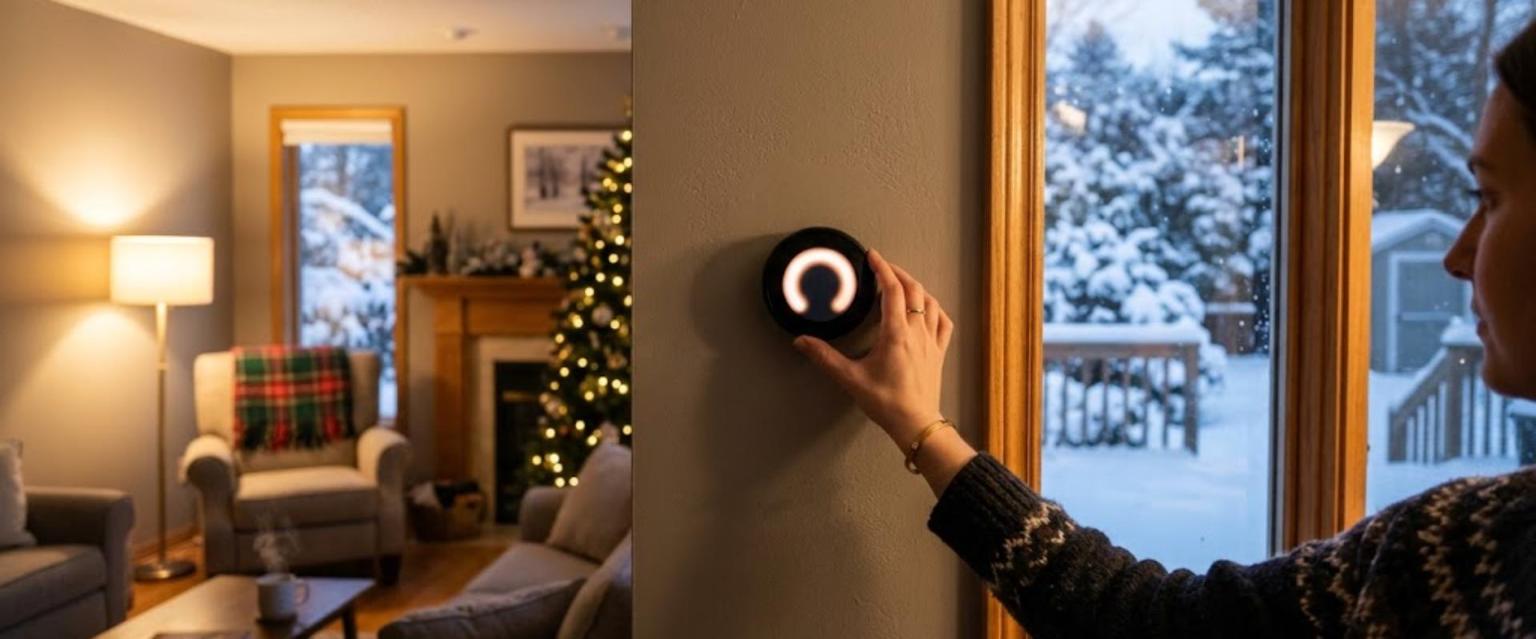
Quick answer: The recommended thermostat settings for most Ontario homes in winter are 20°C (68°F) while you are awake and home, and 17°C (63°F) while you sleep or are out, which matches Natural Resources Canada guidance. In summer, about 26°C (79°F) with low humidity is comfortable. If you heat with a heat pump, keep setbacks to about 2°C so backup heat stays off.
November is when GTA thermostats start working hard. Natural Resources Canada (NRCan) says about 61% of the energy used in the average Canadian home goes to heating, so the number on your wall has a real effect on your gas or hydro bill. Below are the recommended thermostat settings for winter, summer and heat pumps, plus the humidity and thermostat tips our technicians share with homeowners in Markham, Richmond Hill and across the GTA.
What are the recommended thermostat settings for winter in Canada?
For a typical Ontario house heated by a gas furnace, NRCan’s winter heating tips give simple recommended thermostat settings: program 17°C when you are sleeping or not at home, and 20°C when you are awake and at home. Enbridge Gas gives its Ontario customers the same two numbers. Use them as a starting point, then adjust by a degree for your own comfort.
| Situation | Winter (heating) | Summer (cooling) |
|---|---|---|
| Awake and at home | 20°C (68°F) | About 26°C (79°F) with low humidity |
| Asleep | 17°C (63°F) | Your daytime setting or a little warmer, with a fan |
| Out for more than 3 or 4 hours | 17°C (63°F) | A few degrees above your home setting |
| Away a week or longer | Around 17°C, with humidity kept low | Raised, or off if no one is home and humidity stays low |
| Heat pump home | Setbacks of no more than 2°C | Small, steady adjustments |
Daytime when you are home
Twenty degrees, the daytime figure in most recommended thermostat settings, suits most families in a well-sealed home. If you feel chilly, try a sweater first. Every degree matters: NRCan’s Keeping the Heat In guide says a drop of 1°C over an eight-hour period can save about 2 percent on your heating energy consumption.
Overnight while you sleep
Program the setback to start shortly before bedtime and end before you get up, so the house is warm again when your alarm goes off. If you have a baby, an older relative or anyone who feels the cold, setting a little warmer than the recommended thermostat settings is perfectly fine.
When you are out or on vacation
The Keeping the Heat In guide notes that if you are away from home for more than three or four hours, it is worthwhile to turn down the temperature. For longer trips, do not drop much lower than 17°C. The same guide warns that colder settings create a risk of moisture build-up in exterior walls, and that if you go lower for a week or longer you must keep humidity levels low. Ask a neighbour to check the house during cold snaps.
Does turning the heat down at night really save money?
Yes, with a furnace it does. A common myth says your furnace burns more gas warming the house back up than you saved overnight. In reality, a cooler house loses heat to the outdoors more slowly, and that is where the savings come from. NRCan puts it plainly: except for some hydronic systems and heat pumps with slow response times, you can save energy by turning down your thermostat.
Where people go wrong is the size of the drop. A very deep setback makes mornings uncomfortable and tempts you to override the schedule. The recommended thermostat settings above use a moderate 3°C drop for that reason: a setback you keep beats one you keep cancelling. If your bill still seems high, our guide to reasons your heating bill is too high covers the usual suspects.
What is the best thermostat setting for winter with a heat pump?
With a heat pump, the recommended thermostat settings change. According to NRCan’s heat pump guide, heat pumps respond more slowly than furnaces, so they have more difficulty recovering from deep setbacks. When the house falls too far, the thermostat calls for supplementary heat (electric strips or a furnace) until the heat pump catches up, and that eats into the savings you bought the heat pump for.
- Keep setbacks small. NRCan recommends moderated setbacks of not more than 2°C, for example 20°C during the day and 18°C at night.
- Use a smart thermostat built for heat pumps. NRCan suggests a smart thermostat that starts the system early in anticipation of recovery, so the heat pump does the work instead of the backup.
- Let your installer set the backup heat. NRCan says a supplementary set-point 2°C to 3°C below the heat pump set-point is recommended, and to consult your installation contractor on the best value for your system.
- Hybrid systems switch. With a heat pump and gas furnace, only one runs at a time. A technician should set the outdoor switchover temperature for your equipment and energy costs.
- Avoid emergency heat mode. It runs backup heat only, so use it only if the heat pump has stopped working or a technician tells you to.
Read how extreme cold affects heat pump performance, or see Aire One’s heat pump installation and service options for cold-climate models.
What are the recommended thermostat settings for summer?
NRCan’s Keeping the Heat In guide explains that higher indoor temperatures, such as 26°C (79°F), are more comfortable when humidity levels are reduced. For most GTA homes, the recommended thermostat settings for summer look like this:
- Home: start at 25°C to 26°C and adjust a degree at a time.
- Away: raise the setting a few degrees rather than switching the air conditioner off on a humid day, so moisture does not build up indoors.
- Night: keep your daytime setting or go slightly warmer and run a ceiling fan.
- Do not crank it down. Setting 18°C will not cool the house faster on a typical single-stage system. It only runs longer and overshoots.
Our article on how smart thermostats improve summer air conditioning goes deeper on cooling schedules.
How does humidity change the temperature you should set?
Humidity changes how the recommended thermostat settings feel. Dry winter air feels colder, so 20°C with very low humidity can feel chilly. Health Canada recommends keeping indoor relative humidity between 30% and 50%, and suggests an inexpensive hygrometer from a hardware store to measure it. In winter, stay near the lower end on very cold days to avoid window condensation. In summer, a properly sized air conditioner removes moisture as it cools, so 26°C feels comfortable, while an oversized unit can leave the house cool but damp.
For more detail, see the role of humidity in winter comfort.
Programmable or smart: which thermostat makes recommended thermostat settings easier?
NRCan notes that a basic programmable thermostat allows at least two setback and reset periods a day, while adaptive smart models can provide even greater savings over programmable ones.
| Thermostat type | How it works | Best for |
|---|---|---|
| Manual | You change the setting by hand each time | Homes where someone is always in and remembers to adjust |
| Programmable | Runs a fixed daily or weekly schedule | Households with a regular routine |
| Smart (Wi-Fi) | Learns your habits, adjusts from an app and can start recovery early | Changing schedules, travel and most heat pump homes |
Look for an ENERGY STAR certified smart thermostat that is compatible with your furnace or heat pump. Ontario’s Home Renovation Savings Program, run by Save on Energy and Enbridge Gas, has offered rebates on smart thermostats and heat pumps. Rebate amounts change, so check saveonenergy.ca before you buy.
Where your thermostat sits matters
- Inside wall. Mount it on an interior wall at about eye level, not on an outside wall.
- Away from heat sources. Keep it clear of direct sun, lamps, supply registers and the kitchen.
- Away from drafts. Hallways near exterior doors give false readings in winter.
Why does your house still feel cold at recommended thermostat settings?
If 20°C on the thermostat does not feel like 20°C in the living room, the setting is not the problem. Common causes we find on GTA service calls include:
- A clogged furnace filter that chokes airflow to the far rooms.
- Air leaks around windows, doors and the attic hatch.
- Duct or balancing problems that leave one floor or one room colder than the rest.
- A thermostat in the wrong spot or one that reads a few degrees off.
- Ageing or undersized equipment that cannot keep up on the coldest nights.
An Aire One technician can check airflow, calibration and equipment health during a $79 service call, or you can ask about a free Total Home Assessment. See all our heating and cooling services.
Frequently asked questions
What are the recommended thermostat settings in Canada for winter?
Natural Resources Canada suggests 20°C (68°F) when you are awake and at home, and 17°C (63°F) when you are asleep or away. Adjust a degree up or down for comfort.
Does turning the heat down at night save money?
Yes, with a furnace. A cooler house loses heat more slowly, so you use less energy overall. NRCan says a 1°C drop over eight hours can save about 2 percent on heating energy.
Should I turn my heat pump down at night?
Only a little. NRCan recommends setbacks of no more than 2°C for heat pumps, or a smart thermostat that starts recovery early, so backup heat does not run.
What temperature should I set when I go on vacation in winter?
Around 17°C for most homes. Going much colder can raise the risk of moisture build-up in exterior walls, so keep humidity low and have someone check the house.
What is a good thermostat setting for summer?
The recommended thermostat settings for summer are about 25°C to 26°C when you are home and a few degrees higher when you are out. Lower humidity makes a warmer setting feel comfortable.
What indoor humidity should I keep in winter?
Health Canada recommends 30% to 50% relative humidity. On very cold days, stay near the lower end to avoid window condensation.
Get your heating dialled in for winter
Aire One Heating & Cooling has helped Ontario families stay comfortable since 1990. If you want a technician to check your furnace or heat pump, program the recommended thermostat settings into a smart thermostat or find out why one room never warms up, book online, contact us or call 310-HEAT (4328).