
Quick answer: Static pressure in HVAC is the resistance your blower pushes against as air moves through the filter, coil and ducts. Technicians measure total external static pressure (TESP) with a manometer, in inches of water column (in. w.c.). Many residential furnaces and air handlers are rated for about 0.5 in. w.c., but the rating plate on your own equipment sets the limit to compare against.
If a technician has told you your system has high static, or your furnace whistles while some rooms never get enough air, static pressure is probably the reason. This guide explains what static pressure in HVAC means, what a good reading looks like, what pushes it too high and how it gets fixed in Ontario homes.
What is static pressure in HVAC?
Think of it like blood pressure. Your blower is the heart and the ducts are the arteries. When something narrows the path, such as a clogged filter or a crushed duct, pressure climbs and less air reaches your rooms.
Static pressure is the pressure air exerts against the inside of the ductwork, separate from the pressure created by its speed. Because the numbers are small, the HVAC industry measures static pressure in inches of water column, the height a column of water would rise under that pressure. You may also see pascals (Pa). For reference, 0.5 in. w.c. is about 125 Pa.
Supply side vs return side
The return side pulls air from the house back to the furnace or air handler, so it runs below room pressure, like suction. The supply side pushes heated or cooled air out to the rooms at positive pressure. A technician measures both, ignores the plus and minus signs and adds them together. That total is the total external static pressure, or TESP.
| Reading | Where it is taken | What it tells you |
|---|---|---|
| Return static | Return duct, just before the air enters the equipment | How hard the blower works to pull air back |
| Supply static | Supply duct, just after the air leaves the equipment | How much resistance the supply ducts and registers add |
| Pressure drop | Before and after a filter or coil | Whether that one part is too restrictive |
| TESP | Return and supply readings added together | The number compared with the rating plate |
For example, a return reading of 0.20 in. w.c. and a supply reading of 0.30 in. w.c. add up to a TESP of 0.50 in. w.c.
What is a good static pressure in HVAC?
A good static pressure is one at or below what the manufacturer rates the blower for, with airflow that matches the system design. Many residential furnaces and air handlers are rated for a maximum of about 0.5 in. w.c. TESP. In a 2022 study by the FSEC Energy Research Center at the University of Central Florida, the manufacturer limit for the air handlers tested was 0.500 in. w.c. (125 Pa). Your rating plate, usually inside the furnace door, or the installation manual gives the limit for your model.
Higher readings are widespread. The same paper notes that high static pressure is common in central ducts, and the earlier field studies it reviewed found average TESP of roughly 0.41 to 0.55 in. w.c. In other words, a typical home sits close to the limit its equipment was built for, or above it.
Ideal static pressure in HVAC by reading
| TESP compared with the rating | What it usually means | Next step |
|---|---|---|
| Well below the rating | Open, roomy ducts | No action if airflow and comfort are good |
| At or just under the rating | Normal operating range | Keep filters and the coil clean |
| Above the rating | A restriction somewhere in the system | Find the cause: filter, coil, ducts or returns |
| Far above the rating | A serious airflow problem | Book a diagnosis soon to protect the equipment |
What causes high static pressure in HVAC?
High static pressure in HVAC almost always comes down to air struggling to get through something. The usual suspects:
- Restrictive or clogged filters. A dirty filter is one of the most common causes, and a filter that is more restrictive than the system was designed for can raise static even when it is new. In the FSEC study, researchers raised static pressure simply by installing a more restrictive MERV 8 filter at the return. Our guide to furnace filters explains the ratings.
- A dirty evaporator coil. The US Department of Energy notes that dirt on the coil reduces airflow and insulates the coil, reducing its ability to absorb heat.
- Undersized, crushed or kinked ducts. The FSEC paper lists inadequate duct support, tight turns or kinks, undersized ducts and over-compression as common flexible duct errors.
- Too few return grilles. Some older homes have only a few small returns for the whole house.
- Closed or blocked registers. Shutting vents adds resistance. See why closing vents in unused rooms rarely saves money.
- New equipment on old ducts. A larger furnace or air conditioner connected to ductwork sized for older equipment. Read more on HVAC sizing.
Signs of high static pressure in HVAC
- Whistling or rushing air at grilles, registers or the filter slot.
- Weak airflow and uneven rooms. If one room is always too cold or hot, restricted airflow may be part of the story.
- Higher energy bills. The Department of Energy says clogged, dirty filters reduce airflow and significantly reduce efficiency, and that replacing a dirty filter can lower an air conditioner’s energy use by 5% to 15%. Here are more reasons your heating bill is too high.
- Short cycling and limit trips in winter. Low airflow lets the furnace heat exchanger run hot. The high limit safety switch shuts the burners off, then the furnace restarts, over and over.
- A frozen AC coil in summer. The FSEC paper notes that restricted airflow can lead to frost on the coil and lower heating and cooling capacity.
- A louder, harder-working blower. Variable speed blowers keep airflow up by using more energy, and the researchers suspect long-term operation above rated static may shorten blower motor life.
How is static pressure in HVAC measured?
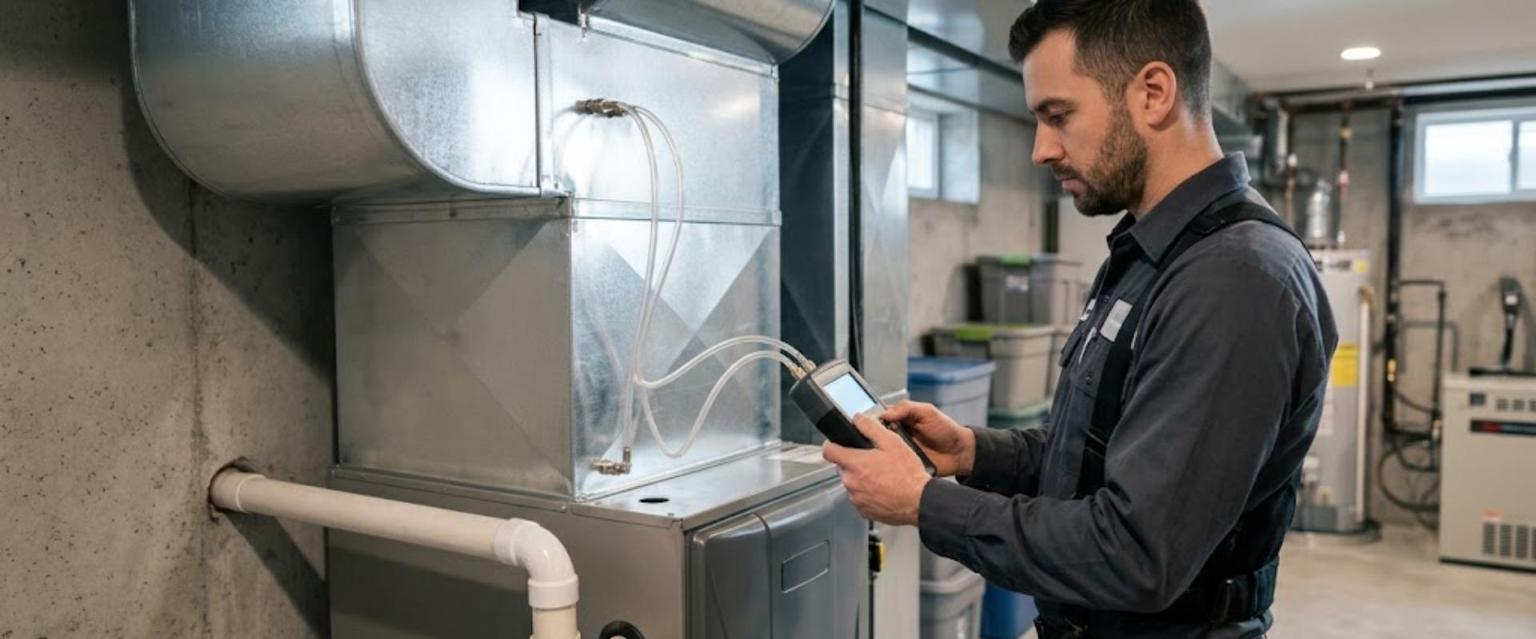
A technician uses a digital manometer and static pressure probes placed in small test ports in the return and supply ducts near the equipment. Readings are taken with the blower at its normal speed, then compared with the rating plate and the manufacturer’s fan tables to estimate airflow. Checking the pressure drop across the filter and coil shows which part is causing the restriction.
Please do not drill test ports yourself. A hole in the wrong spot can damage the coil or wiring, and ports must be sealed and plugged afterward to avoid air leaks. Furnace work involving burners or the gas supply must be done by a TSSA-registered contractor. If you ever smell gas, leave the home, then call Enbridge Gas at 1-866-763-5427 or 911 from outside.
How to fix high static pressure in HVAC
Most fixes for high static pressure in HVAC start with the simplest, most likely cause.
- Change the filter on schedule. Ask your technician which filter type and MERV rating your system can handle. A thicker media filter cabinet often gives better filtration with less resistance than a thin, restrictive filter.
- Open and clear registers and returns. Move furniture and rugs off grilles and keep supply vents open.
- Clean the coil and blower. This is part of a proper tune-up. A maintenance protection plan keeps it on schedule.
- Add or enlarge return air. A new return in a busy upstairs hallway or bedroom often makes a big difference.
- Repair or replace problem ductwork. Straighten and support flex duct, replace crushed sections and enlarge undersized trunks.
- Match the equipment to the house. When it is time to replace, a properly sized system matched to your ducts avoids the problem. See furnace replacement options.
A variable speed blower holds airflow steadier against resistance, but it does not remove the restriction. The FSEC researchers found that this type of motor uses more energy to push through it.
What does low static pressure in HVAC mean?
Low static pressure is not automatically a problem. A low TESP with strong, even airflow usually means the ductwork is roomy and open, which is what you want. A low reading with weak airflow can point to a disconnected or badly leaking duct, a blower set too low or a missing filter, which lets dust coat the coil and blower.
Frequently asked questions
What is a good static pressure in HVAC?
A good reading is at or below the total external static pressure on your equipment rating plate. Many residential furnaces and air handlers are rated for about 0.5 inches of water column, but always check the plate or installation manual for your model.
What does high static pressure in HVAC mean?
The blower is pushing against more resistance than it was designed for, usually above the TESP on the rating plate. Common causes are restrictive filters, a dirty coil, undersized or crushed ducts and too few returns.
Can a dirty filter cause high static pressure?
Yes. A clogged filter adds resistance on the return side and reduces airflow. An overly restrictive filter can do the same, even when it is new.
Can I check static pressure myself?
It is best left to a technician. Measuring TESP takes a manometer and properly placed, sealed test ports, and the readings are compared with the manufacturer fan tables.
Is low static pressure bad?
Not by itself. Low static with strong, even airflow usually means open, well-sized ducts. Low static with weak airflow can point to a disconnected duct, a large leak or a blower set too low.
Can high static pressure damage a furnace?
It strains the system. Low airflow makes the heat exchanger run hot and can trip the high limit switch, and in summer it can freeze the AC coil. Researchers also suspect long-term high static may shorten blower motor life.
Get your static pressure tested by Aire One
If your system whistles, short cycles or leaves rooms uncomfortable, testing static pressure in HVAC equipment is often the fastest way to find out why. Aire One technicians take the readings, explain them in plain language and recommend the simplest fix first. We have served GTA homeowners since 1990. Start with a $79 service call from our HVAC servicing and repairs team: book online or call 310-HEAT (4328).