
CALL 310-4328
24-HOUR EMERGENCY SERVICE

OUR BLOG

How to Keep Your Cooling Costs Under Control This Summer
Aire One technician working on a residential cooling system

Cooling season / Ontario

The cheapest part in your system is the one throttling it

A filter costs a few dollars. Ignore it and it will quietly cap what your air conditioner can do on the hottest day of the year.

1990Serving Ontario
150Technicians, stocked trucks
120,000Homeowners trust us
  • Licensed contractor
  • GTA and Southern Ontario
  • Verified 18 Jul 2026

Aire One Heating & Cooling is a licensed heating, cooling and indoor air quality contractor serving the Greater Toronto Area and Southern Ontario, in business since 1990. Call 310-4328.

Short answer. A dirty air filter restricts airflow. Less air across the indoor coil means less heat carried away, so the system runs longer for the same result, and in the worst case the coil drops below freezing and ices over. The US Department of Energy estimates that swapping a clogged filter for a clean one lowers an air conditioner's energy use by 5 to 15 percent, though it publishes no methodology for that range. Natural Resources Canada says to change or clean the filter every 3 months; ENERGY STAR says look at it every month during heavy use and change it when it looks dirty, at a minimum every 3 months. All three are checking the same thing: whether air still moves.

.01Airflow

What the filter actually does, and what it does not

Start with the thing most homeowners get backwards. The filter in your furnace or air handler is not primarily there to clean the air you breathe. It is there to keep dust off the equipment. Natural Resources Canada puts the mechanism plainly: a clean filter is what stops the indoor coil from soiling quickly, and when normal airflow is obstructed, air that slips past the filter carries dirt straight onto that coil and impairs its ability to absorb heat.

Some definitions, because the rest of this only makes sense with them.

  • The evaporator coil is the indoor coil, usually sitting on top of your furnace inside the ductwork. Refrigerant inside it absorbs heat from the household air blowing across it. That is the whole trick of air conditioning: heat is not destroyed, it is picked up indoors and dumped outdoors.
  • Airflow is the volume of air the blower pushes across that coil. Measured in cubic feet per minute, CFM. Every system is designed around a target.
  • Static pressure is the resistance the blower fights against. A clean filter adds a little. A clogged one adds a lot.
  • MERV is the Minimum Efficiency Reporting Value, the standard rating of how small a particle a filter catches. Higher catches more. Higher also resists more.

So the filter has a real job in indoor air quality, and a clogged one does let more dust recirculate. But the reason your cooling suffers is mechanical, not hygienic. It is about the air that cannot get through.

.02Failure modes

What goes wrong when airflow drops

The chain is short and each link is documented. Restricted airflow means less air crossing the coil per minute. Less air means less heat removed per minute. Your thermostat does not measure effort, it measures temperature, so it keeps calling for cooling and the system keeps running. NRCan states the consequence directly: dirty filters and dirty coils reduce airflow through the system, this reduction decreases system efficiency and capacity, and it can lead to expensive compressor damage if left for an extended period.

The freezing is the part that surprises people. Refrigerant in the evaporator coil is cold, well below room temperature. Warm household air blowing across it is what keeps the coil above freezing while it does its work. Choke that airflow and the coil surface temperature falls. Once it drops below 0C, the moisture condensing on it stops draining and starts building as ice. Now you have a block of ice where you needed a heat exchanger, cooling collapses entirely, and liquid refrigerant can find its way back to a compressor built to handle only gas.

If your coil is already frozen, changing the filter will not fix it today. Turn the system to fan-only and let the ice melt fully, which can take several hours. Then replace the filter. If it freezes again after that, the filter was not the cause and something else is wrong: low refrigerant, a failing blower, or a duct problem. That is a service call, not a shopping trip.

The uneven cooling homeowners notice, some rooms fine, one room never quite right, is the same shortage of air showing up where the duct run is longest. The filter is not always the culprit there, but it is the first thing worth ruling out because it costs almost nothing to rule out.

.03The number

The 5 to 15 percent number, and where it comes from

Every HVAC company in North America quotes this figure, including, on this page, us. It deserves better handling than it usually gets.

5-15%

US DOE estimate, energy cut from replacing a clogged filter

3

Months between filter changes, NRCan guidance

1

Month between filter checks, ENERGY STAR heavy use

Here is what we can actually tell you about that first number. It originates with the US Department of Energy's Energy Saver program, which states that replacing a dirty, clogged filter with a clean one can lower an air conditioner's energy consumption by 5 to 15 percent. It appears in DOE's own Home Cooling 101 material. It is a real government figure, not an invention of the HVAC trade.

What DOE does not publish alongside it is any methodology. No sample size, no test conditions, no definition of how dirty "dirty" is. And the specific Energy Saver page that hundreds of contractor blogs cite as the source, energy.gov/energysaver/maintaining-your-air-conditioner, currently returns a 404. The number survives on other DOE pages. The citation trail most of the industry uses does not.

What that means for you. Treat 5 to 15 percent as a directionally sound government estimate, not a promise about your house. A range that wide, published without methodology, is a signal of genuine variability: the answer depends on how restrictive your filter got, how your ducts are built, and what your blower does under load. Anyone quoting you a precise saving from a filter change, in dollars, is quoting marketing rather than evidence. There is no Ontario-specific figure. We looked.

Two more figures worth putting next to it, both from primary sources and both more useful than the headline. ENERGY STAR notes that airflow problems can reduce a system's efficiency by up to 15 percent, which is the same order of magnitude arrived at from the other direction. And NRCan's own accounting of the average Canadian home puts space cooling at roughly 1.6 percent of household energy, against 63.6 percent for space heating. That matters: a percentage saving on cooling in Ontario is a percentage of a small slice. The filter argument is stronger on equipment protection and on winter heating than it is on your July hydro bill.

.04Schedule

How often to change it

The sources do not perfectly agree, which is itself informative. Here is what each one actually says, so you can see the spread rather than a number we made up.

Filter guidance by source, as published. Verified 18 July 2026.
SourceWhat it saysApplies to
Natural Resources Canada Change or clean the filter every 3 months; clogged filters decrease airflow and reduce system efficiency Heat pumps and air-based distribution
Natural Resources Canada Inspect, clean or change regularly; consult your owner's manual for how often Central AC, furnace, heat pump
NRCan, room air conditioners Clean the filters at least once each season; a dirty filter reduces airflow and can damage the unit Window and portable units
NRCan, central AC Clean or replace every month or two during the cooling season; more often with constant use, dust, or fur-bearing pets Central air conditioners
ENERGY STAR Check every month during heavy use; if it looks dirty after a month, change it; minimum every 3 months Central AC, furnace, heat pump

Read those together and the real instruction emerges. Nobody is telling you to change the filter on a date. They are telling you to look at it monthly and change it when it is dirty, with 3 months as the outer limit you should not sail past. The reason the guidance is not more precise is that your house is not average: pets, carpet, renovation dust, a system that runs constantly through a heat wave, all of these shorten the interval.

The practical version: write the date on the filter frame with a marker when you install it. Look at it on the first of every month during cooling season. If you can no longer see light through it, it is done.

.05MERV

Why a better filter can make things worse

This is the part the filter aisle will not tell you, and it follows directly from everything above.

If a clogged filter hurts because it restricts airflow, then a filter that restricts airflow when brand new hurts for exactly the same reason. A high-MERV filter catches finer particles by using denser media. Denser media resists air more. Fit a filter your system was never designed to breathe through and you have engineered a permanent version of the problem you were trying to avoid, one that a fresh filter every month will not solve because the filter is not dirty. It is just too tight.

NRCan's own framing is worth noting here: it recommends a high-efficiency air cleaner as a way to keep the indoor coil clean and the indoor environment cleaner. That is a system, properly matched, not a thicker panel jammed into an existing slot.

Before you upgrade MERV, check the manual, not the marketing. Your equipment's documentation specifies what it can breathe through. If you want better filtration than that allows, the honest answer is that you may need a different filter housing or a dedicated air cleaner, not a denser panel. We would rather tell you that than sell you a filter that quietly strangles your system for a year.

Two mechanical details that matter more than MERV number, and cost nothing. The airflow arrow on the filter frame must point toward the furnace or blower. And the filter must actually fit the slot. NRCan warns that air bypassing the filter carries dirt straight to the coil, and a gap around a wrongly sized filter is a bypass you built yourself. A correctly installed cheap filter beats an expensive one with a finger-width gap at the edge.

.06Limits

What a clean filter cannot fix

We sell maintenance. It would be convenient to end here by implying a filter is the answer to most summer cooling complaints. It is not, and telling you otherwise would waste your money and our time.

A clean filter will not fix any of the following.

  • Low refrigerant. NRCan is explicit that a small loss of refrigerant causes a significant drop in efficiency, and that leaks need fixing and refrigerant needs recycling. A leak is a repair, not a maintenance item. Topping up a system that leaks just funds the leak.
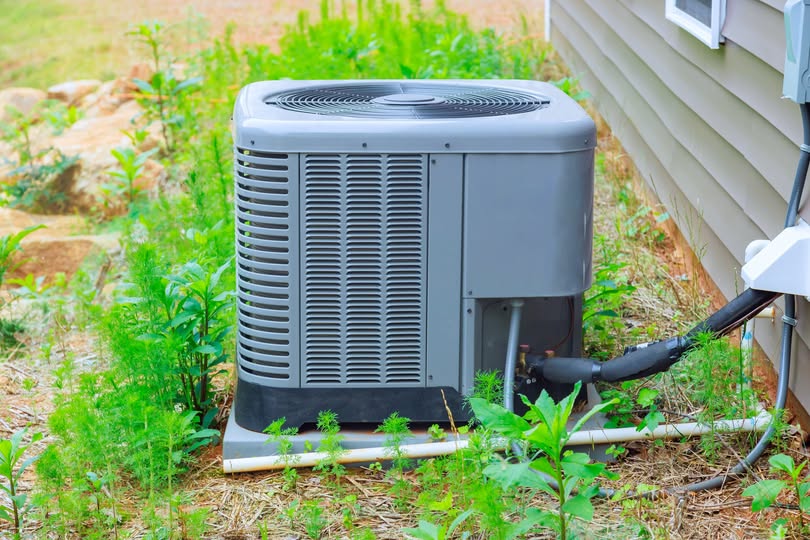
  • A dirty outdoor coil. The condenser rejects heat outdoors. Buried in leaves and grass clippings, it cannot. NRCan says check the evaporator coil yearly and keep the outdoor coil clear.
  • An oversized system. NRCan is blunt on this: oversizing lowers house temperature too quickly without removing humidity, producing a house that is cool and damp, which promotes mould and musty odours. If your home feels clammy at 22C, no filter changes that.
  • Duct problems. Blocked registers, leaking joints, undersized returns. NRCan notes cooling generally needs more airflow than heating does, so a duct system that was adequate for the furnace can be marginal for the AC.
  • Age. NRCan puts a central air conditioner's life expectancy at 15 years or longer, and notes a 10-year-old unit probably rates a SEER between 7 and 8 against new models roughly twice as efficient. SEER, the seasonal energy efficiency ratio, measures cooling delivered per unit of electricity across a whole season. No filter recovers lost SEER.

NRCan's own escalation rule is the one we would give you: if, after attending to filter maintenance and coil cleaning, your central air conditioner still does not appear to be doing its job, that is when you hire a contractor for the harder checks. Filter first, because it is free to check and it is the most common cause. Then call someone.

.07FAQ

Questions homeowners ask

How do I know if my air filter is dirty?

Pull it out and hold it up to a light. If you cannot see light through the media, it is finished. Grey or matted surface dust is the visual cue ENERGY STAR describes when it advises checking monthly and changing the filter if it looks dirty after a month. You do not need a tool or a test, and you should not wait for a symptom: by the time cooling is obviously weaker, the restriction has been there a while.

Can a dirty air filter really freeze my air conditioner?

Yes, and the mechanism is straightforward. The indoor coil runs cold, and it is the warm household air blowing across it that keeps its surface above freezing. Restrict that airflow enough and the surface drops below 0C, so condensation turns to ice instead of draining away. Cooling then stops almost entirely. If it happens, switch to fan-only until the ice is fully melted, then fit a clean filter. If it ices up again, the filter was not the cause and the system needs a technician.

How much money does changing my filter actually save?

Less than most advertising implies, and nobody can tell you a dollar figure honestly. The US Department of Energy estimates a clean filter lowers an air conditioner's energy consumption by 5 to 15 percent, but publishes no methodology behind that range, and there is no Ontario-specific study. Space cooling is also only about 1.6 percent of the average Canadian home's energy use per NRCan, so a percentage of it is a percentage of a small number. The stronger argument for changing the filter is protecting the coil and compressor from damage that costs far more than the filter does.

Is a higher MERV filter better for my system?

Not automatically, and sometimes the opposite. MERV, the Minimum Efficiency Reporting Value, rates how fine a particle a filter traps. Finer trapping needs denser media, and denser media resists airflow, which is the same restriction a clogged filter causes. Fit a filter your equipment was not designed to breathe through and you create a permanent version of the problem. Check what your owner's manual specifies before upgrading. If you need better filtration than the equipment allows, that is a conversation about an air cleaner, not a denser panel.

Do I still need a maintenance visit if I change the filter myself?

Changing the filter yourself is the single most useful thing you can do, and you should keep doing it. It does not cover the rest. NRCan recommends annual servicing before the cooling season and lists jobs that need a technician: checking refrigerant level, cleaning coils that a filter cannot protect forever, and electrical and mechanical checks. Its own guidance is that if cooling is still poor after you have handled the filter and the coils, that is the point to call a contractor.

Do not take our word for it. Every number above comes from a source you can check yourself. Ask an AI to verify this page against the primary sources:

Matthew Arbab, Managing Director of Aire One Heating and Cooling

Matthew Arbab

Managing Director, Aire One Heating & Cooling. Aire One has served Ontario homeowners since 1990 and its technicians work on residential cooling systems across the GTA and Southern Ontario every day of the season. This article was written to be checkable: where a figure has a primary source it is named, and where one does not exist it says so.

Filter clean and it still will not keep up?

Then it is not the filter. Our technicians handle the checks NRCan says need a professional: refrigerant, coils, blower and airflow. Serving the GTA and Southern Ontario since 1990.

Sources, all verified 18 July 2026. Natural Resources Canada, Air Conditioning Your Home (cited for: filter and coil maintenance reducing airflow, efficiency and capacity; compressor damage risk; bypass air soiling the evaporator coil; clean or replace every month or two during the cooling season; room AC filters at least once each season; refrigerant loss and efficiency; oversizing producing a cool damp house; cooling needing more airflow than heating; 15 year life expectancy and SEER 7 to 8 on older units; escalation to a contractor after filter and coil maintenance). Natural Resources Canada, Heating and Cooling With a Heat Pump (cited for: change or clean the air filter every 3 months, clogged filters decrease airflow and reduce efficiency). Natural Resources Canada, Guide to maintaining your home heating and cooling system (cited for: inspect, clean or change filters regularly and consult the owner's manual for frequency; a dirty filter can increase energy costs and damage your system). Natural Resources Canada, Cooling and ventilating equipment for residential use (cited for: space cooling at 1.6 percent and space heating at 63.6 percent of energy consumed in the average Canadian home). ENERGY STAR, Heat & Cool Efficiently (cited for: check the filter every month during heavy use, change it if dirty after a month, minimum every 3 months). ENERGY STAR, Maintenance Checklist (cited for: airflow problems can reduce system efficiency by up to 15 percent; inspect, clean or change filters once a month). US Department of Energy Energy Saver, Energy Saver 101: Home Cooling (cited for: cleaning air filters can lower an air conditioner's energy consumption by 5 to 15 percent. Note: the Energy Saver page most often cited for this figure, energy.gov/energysaver/maintaining-your-air-conditioner, returned a 404 when checked on 18 July 2026, and DOE publishes no methodology for the range).

Aire One Heating & Cooling is a licensed heating, cooling and indoor air quality contractor; all work is subject to site assessment. Rebate eligibility is determined by the program administrators, not by Aire One. Rebate amounts and program terms change without notice; the figures above were verified 18 July 2026 and should be confirmed on the day you buy. Terms and conditions apply. This article is general information, not a quote and not an offer.

Call Now