

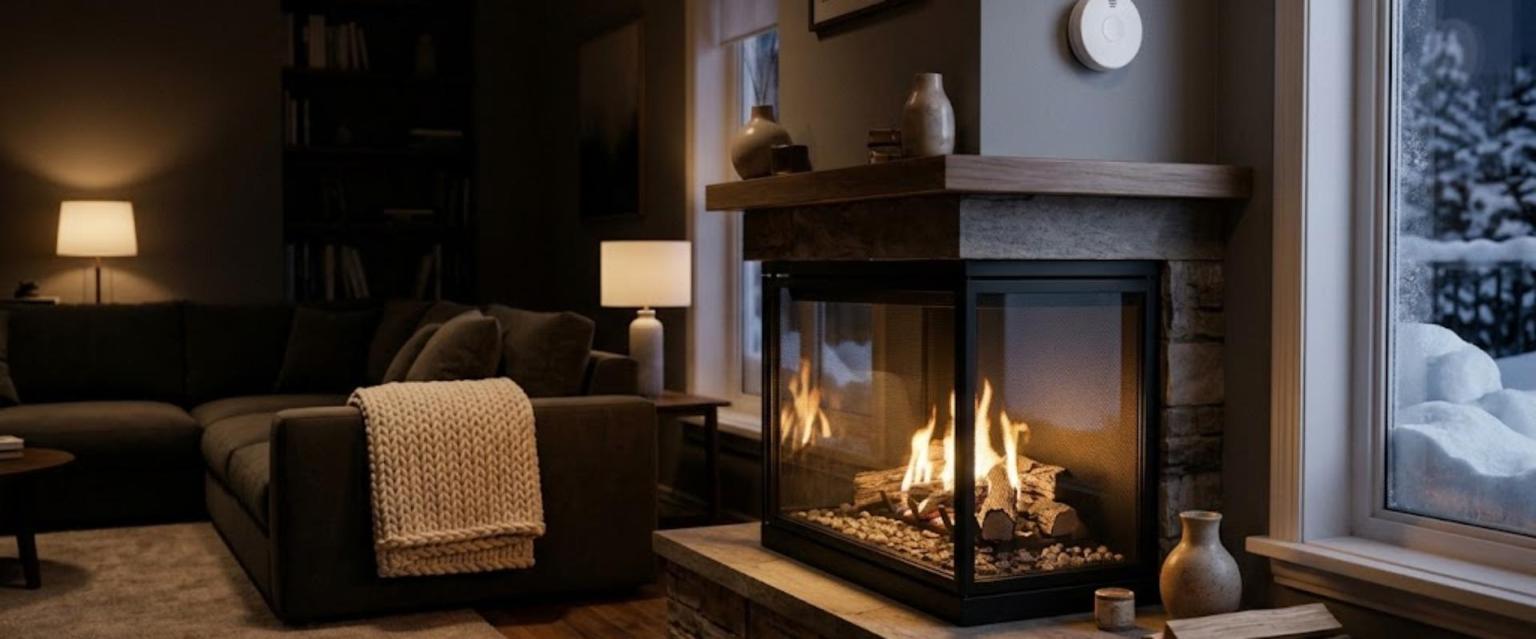
Quick answer: For most homes, leaving a gas fireplace on overnight is not a good idea. Unless your owner’s manual clearly says the model is approved for continuous, unattended use, turn the flame off before bed. Sealed direct-vent units are the safest type, but they still need yearly servicing and working CO alarms. A standing pilot light left on overnight is normal if the manual allows it.
On a cold GTA night, it is tempting to doze off in front of the fireplace. Homeowners ask us all the time whether it is safe to leave a gas fireplace on overnight, and the honest answer is that it depends on the type of fireplace you own and what its manual says. This guide explains the difference between fireplace types, what to do about the pilot light, and the safety steps every Ontario home with a gas fireplace should have in place.
Can you leave a gas fireplace on overnight?
The rule that matters most is the one printed in your owner’s manual. Each model is tested and certified for a specific use, and the manual tells you whether it is rated as a heater or as a decorative appliance, whether it may run unattended, and what clearances it needs. Natural Resources Canada (NRCan) even warns buyers to be careful when comparing the ratings of appliances classed as decorative and heater.
If the manual does not clearly allow continuous, unattended use, the safe default is simple: switch the flame off before you go to sleep. That is the advice Aire One gives most households, especially homes with young children or pets, older units, or a fireplace that has not been serviced this season.
Never keep a gas fireplace on overnight if any of these apply:
- The glass is cracked. Enbridge Gas says never to use a fireplace with cracked glass and to have it inspected or replaced by a TSSA-registered contractor.
- You do not have a working carbon monoxide (CO) alarm. It is also an Ontario legal requirement, as explained below.
- Something has changed. The flame looks different, soot is building up on the glass, or you notice an odd smell.
- It has not been serviced in the past year.
- Snow or ice may be covering the outside vent. Our guide to a vent blocked by snow explains why this matters for every gas appliance.
- You are not sure what type of fireplace you have.
Is it safe to leave a gas fireplace on overnight? It depends on the type
NRCan’s guide to gas fireplaces describes three venting designs, and the design affects whether leaving a gas fireplace on overnight is ever reasonable.
| Fireplace type | How it vents | Overnight use |
|---|---|---|
| Direct vent (sealed) | Brings in outdoor air and sends exhaust outside through sealed pipes, so no room air is used for combustion | Lowest risk type, but only run it unattended if the manual allows it |
| B-vent (natural draft) | Uses room air and relies on a vertical vent and rising hot gases to carry exhaust out | Turn it off before bed, since it depends on a good chimney draft to clear exhaust |
| Vent-free (unvented) | Does not vent outdoors, so combustion gases enter the house | NRCan says these units are not approved for use in Canada |
Do not guess which type you have. The rating plate and the manual list the venting type, and a licensed gas technician can confirm it during an annual inspection. If you are curious about the upsides of a modern unit, see the benefits of a gas fireplace.
Is it OK to leave the pilot light on a gas fireplace overnight?
Yes, on most fireplaces that use one. A standing pilot is designed to burn continuously, so leaving it lit overnight, or all winter, is normal operation when the manual allows it. Leaving the pilot lit is not the same as leaving the gas fireplace on overnight with the main burner going.
- It does use gas. NRCan says a pilot light on its own can consume from 600 to 1500 Btu of gas per hour, and suggests turning it off when the fireplace is not being used, especially during the summer.
- The remote may not shut it off. NRCan notes that remote controls and wall switches often control the main flame while leaving the pilot running.
- Newer units may have no standing pilot at all. Many use electronic ignition that lights the flame only when you want heat.
- Turning it off or back on: follow the instructions on the appliance label or call a licensed technician. If you smell gas, do not try to light anything.
Our article on the basics of pilot lights explains how standing and electronic ignition systems differ.
What are the risks of leaving a gas fireplace on overnight?
- Carbon monoxide. Any fuel-burning appliance can produce CO if venting fails, a vent is blocked or a seal is damaged. Ontario lists headaches, nausea, dizziness, confusion and drowsiness among the symptoms. If you leave a gas fireplace on overnight and something goes wrong while you sleep, you will not notice those symptoms, which is why alarms matter so much.
- Hot glass and surfaces. The glass front gets hot enough to burn and stays hot for a while after the flame goes out. Keep the barrier screen in place and keep children and pets back.
- Overheating the room. NRCan warns that a fireplace thermostat could cycle the unit on even when the room is not being used or no one is home.
- Things too close to the fire. Blankets, stockings, decorations and furniture must stay outside the clearances listed in the manual.
- Extra wear and gas use. Long run times add up on your bill and on parts such as gaskets and igniters.
Ontario CO alarm rules for homes with a gas fireplace
Whether or not you ever run your gas fireplace on overnight, the alarm rules apply. Ontario’s carbon monoxide safety rules require a CO alarm in any house with a fuel-burning appliance, a fireplace or an attached garage. The alarm must be adjacent to each sleeping area, such as the hallway outside the bedrooms, and since January 1, 2026, on every storey of the home, including storeys without bedrooms.
- Add one near the fireplace if it is not a sealed direct-vent unit, as NRCan suggests.
- Test alarms monthly and replace batteries as needed, as Enbridge Gas recommends.
- Replace the alarm itself by the date in the manufacturer’s instructions.
How to run a gas fireplace on overnight safely, if your manual allows it
If your manual says your model may run unattended for long periods, these habits keep the risk low:
- Book an annual inspection. Enbridge Gas recommends a yearly service visit from a TSSA-registered HVAC contractor, and TSSA says all fuel-burning appliances should be inspected annually. Read why gas fireplaces need annual inspections.
- Use the lowest comfortable setting. A thermostat-controlled fireplace on low is better than a high flame all night. Our guide to recommended thermostat settings covers night temperatures.
- Keep the screen on. The barrier screen protects little hands and paws from the hot glass.
- Clear the outside vent. After every snowfall, check that the vent terminal is free of snow and ice.
- Respect clearances. Keep anything soft or flammable off the hearth and outside the clearances in your manual.
A maintenance protection plan is an easy way to make sure the yearly fireplace check never slips.
When should you turn it off and call a technician?
If you see soot on the glass, a flame that looks noticeably different, a pilot that keeps going out or cracked glass, or you hear unusual noises, shut the fireplace off and book a licensed gas technician. Do not run your gas fireplace on overnight again until it has been checked, and do not try to repair gas parts, valves or ignition yourself.
If you smell gas: leave the home right away without using light switches or phones inside, then call Enbridge Gas at 1-866-763-5427 or 911 from outside. If your CO alarm sounds: get everyone out immediately and call 911 from outside the building, as Ontario advises.
Frequently asked questions
Can I leave my gas fireplace on overnight while I sleep?
Only if your owner’s manual clearly allows continuous, unattended use. Otherwise, turn the flame off before bed. Even with an approved unit, you need working CO alarms and a yearly inspection.
Is it OK to leave the pilot light on all winter?
On most fireplaces with a standing pilot, yes. It is designed to stay lit. NRCan suggests turning it off when the fireplace is not in use, especially in summer. Follow your manual.
How long can a gas fireplace stay on?
There is no single limit for every model. Your owner’s manual sets the safe run time and says whether the unit can operate unattended, which decides whether you can keep a gas fireplace on overnight. If you cannot find the manual, ask a licensed gas technician.
Do I need a carbon monoxide alarm if I have a gas fireplace?
Yes. Ontario requires a CO alarm in homes with a fuel-burning appliance or fireplace, adjacent to each sleeping area and, since January 1, 2026, on every storey.
Are vent-free gas fireplaces allowed in Canada?
NRCan says vent-free gas fireplaces are not approved for use in Canada because they release combustion gases into the house. If you think you have one, have a technician check it.
How often should a gas fireplace be inspected?
Once a year by a TSSA-registered contractor, ideally before the heating season starts.
Book your gas fireplace safety check
Aire One Heating & Cooling has serviced gas appliances in Ontario homes since 1990, and our licensed technicians can tell you whether leaving your gas fireplace on overnight is allowed for your model, then clean and inspect it and check the venting. Explore our fireplace services and installations, book online, contact us or call 310-HEAT (4328).