
Boiler Pressure Too High?
What your gauge is telling you, why pressure climbs and when a technician needs to come out today.

The short answer: Boiler pressure too high shows up as a gauge reading well above its usual level or in the red zone, often with a dripping relief valve. Many home hot-water systems run at roughly 12 to 15 psi when cold and a few psi higher when hot, but the label on your boiler sets the real limits. Common causes are a failed expansion tank, a faulty fill valve, overfilling or overheating. Turn the thermostat down, stay clear of the relief valve pipe, never cap it, and call a licensed technician.
A hot-water boiler is a closed, pressurized system, and a few small parts control how its water expands as it warms. When one fails, the needle creeps upward. Finding your boiler pressure too high on a cold morning is worrying, but it points to one specific part that needs attention.
For no heat, leaks or noises, see our guide to common boiler problems. If the relief valve is already releasing water, book a service visit online or call 310-HEAT at any hour.
Read Your Boiler Gauge at a Glance
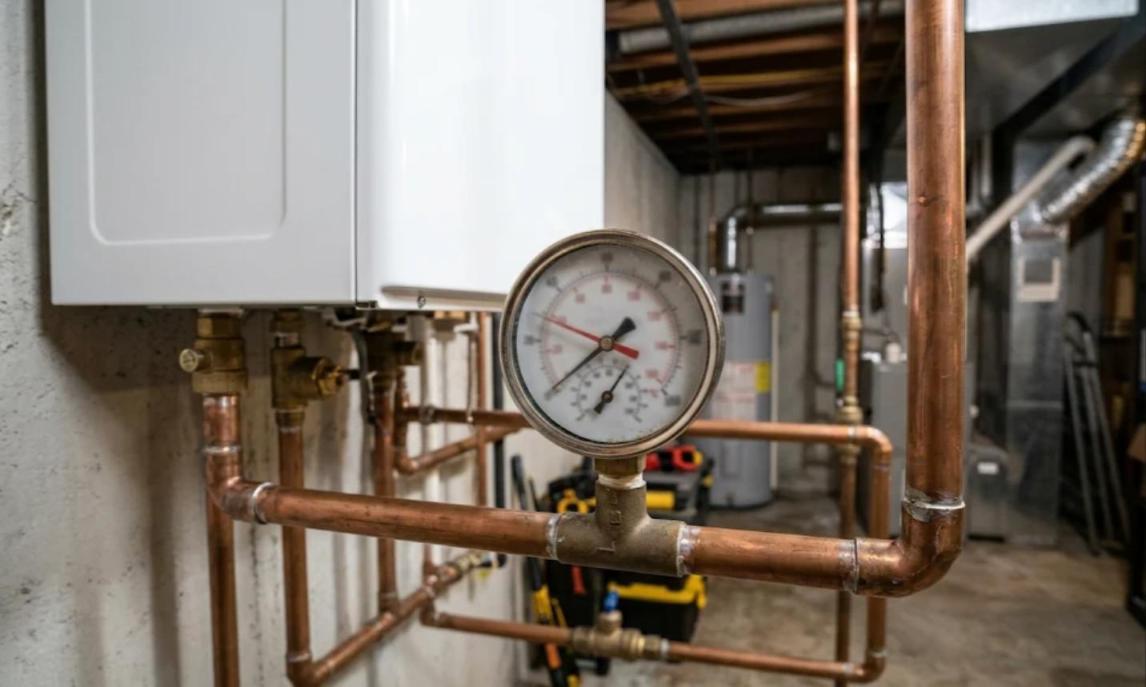
The gauge sits on the boiler or the piping above it. Older boilers use a combination gauge, or tridicator, that also shows temperature. Read the psi scale.
Typical ranges only. Your boiler's rating plate, relief valve tag and manual set the real limits.
Photograph the gauge in the morning and after an hour of heating. Two photos let a technician spot boiler pressure too high faster than any description.
What Counts as Boiler Pressure Too High, Cold and Hot?
When the system is cold
Many residential systems are filled to roughly 12 to 15 psi (about 83 to 103 kPa). One major manufacturer lists 12 psi as typical for a home, noting that it varies by system. Taller homes often need more.
When the system is hot
Heated water expands, so pressure normally rises a few psi. On a healthy system, it stays well below the relief rating. One manufacturer's manual flags hot-water readings above 24 psi as a possible expansion tank or gauge problem.
Treat it as boiler pressure too high when the gauge reads well above its normal level, jumps more than usual between cold and hot, or nears the relief valve rating. That rating is often 30 psi (about 207 kPa), but check your valve's tag and the rating plate. These numbers apply to hot-water boilers, not steam.
Why Is My Boiler Pressure Too High? Five Common Causes
Each cause of boiler pressure too high leaves its own pattern on the gauge, which helps you describe the problem when you call.
1A failed expansion tank
This small tank holds a cushion of air behind a rubber diaphragm that absorbs expanding water. If the air charge leaks away or the diaphragm fails, pressure spikes every time the boiler fires.
Typical pattern: Normal cold, sharply higher hot.
2A faulty pressure-reducing (fill) valve
This valve lowers city water pressure to what the heating system needs and tops up small losses. If it wears out or debris holds it open, city water keeps seeping in.
Typical pattern: High even when cold, creeping up day after day.
3Overfilling
If the system was topped up by hand, or a fill valve was left open after a repair, it holds too much water and has less room to expand.
Typical pattern: Pressure jumped soon after someone added water.
4Overheating
Hotter water expands more. A faulty temperature control or high-limit switch can let water overheat, which is also a safety issue.
Typical pattern: Unusually hot pipes, a high temperature reading, or banging and hissing.
5An internal leak or a faulty gauge
On boilers that also heat tap water, a leak inside the domestic coil or heat exchanger can let city water into the heating side. Sometimes the gauge itself is stuck.
Typical pattern: A combination boiler that keeps gaining pressure, or a needle that never moves.
The Relief Valve: Your Boiler's Last Line of Defence
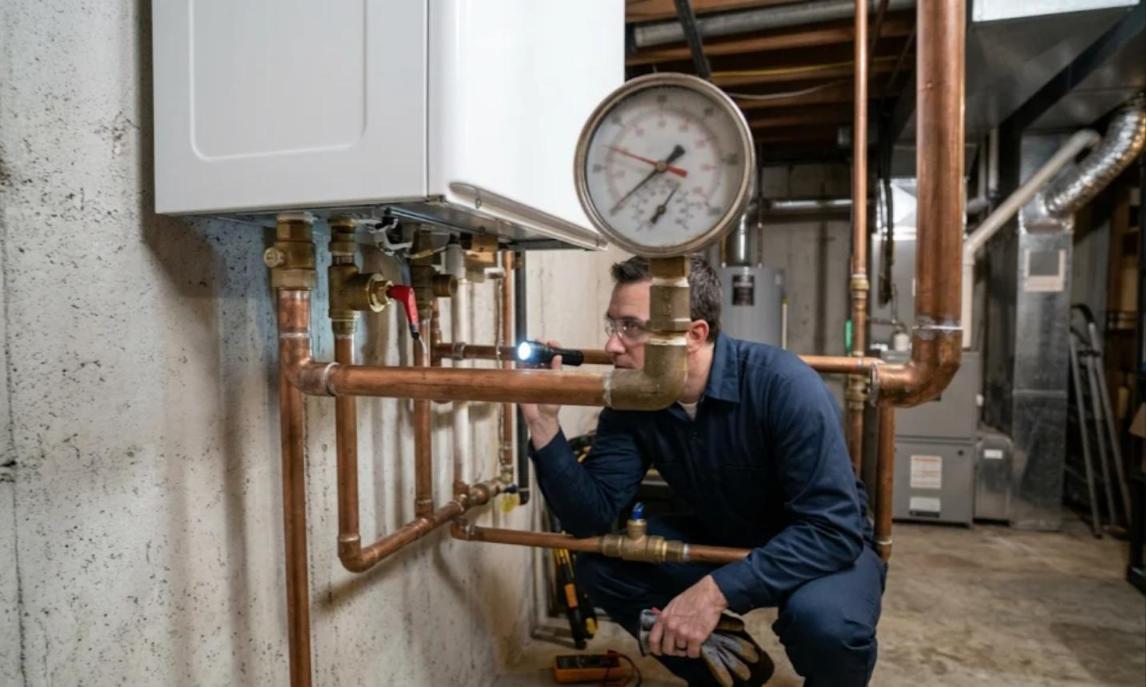
Every hot-water boiler has a pressure relief valve, usually brass with a small lever and a pipe running toward the floor. If pressure reaches its rating, it opens, lets hot water out, then closes again. With boiler pressure too high, that release protects the boiler, the piping and your family.
Never cap, plug or remove the relief valve or its discharge pipe. A blocked relief valve turns a nuisance drip into a serious hazard. The water can be scalding, so keep children and pets away and do not touch the pipe.
A drip means pressure reached the limit, and the valve may now be worn. Enbridge Gas advises regular checks that relief valves work and have not seized. A licensed technician tests the valve, fixes the reason pressure climbed and replaces the valve if needed.
Boiler Pressure Too High? Warning Signs to Watch For
Pressure hit the valve's limit, or the valve is worn.
The valve opened, even if you never saw it.
Near or past the relief rating. Call now.
A classic expansion tank sign.
Points to a leaking fill valve.
Many wall-hung boilers stop firing and show a code.
Banging, hissing or steam can mean overheating and is urgent. Even one drip deserves a call, because relief valves should not open in normal use.
What to Do Right Now, and What Never to Do
Safe for homeowners
- Turn the thermostat down so the boiler stops firing and the water cools.
- Keep everyone away from the relief valve pipe.
- If you can do it without touching anything hot, set a pail under the pipe.
- Photograph the gauge and any fault code.
- Note when it started, such as after a repair or a top-up.
Never do this
- Cap, plug or block the relief valve or its pipe.
- Drain water or bleed radiators to lower pressure.
- Add water or open the fill valve.
- Adjust the pressure-reducing valve, expansion tank or any other valve.
- Remove covers or touch wiring, burners or gas parts.
- Keep resetting the boiler after a lockout.
With boiler pressure too high, draining water looks like an easy fix, but it risks scalds and flooding and hides the real fault. If water is near outlets or electrical parts, stay back and call. The Technical Standards and Safety Authority (TSSA) notes that under Ontario law, fuel-fired appliances must be maintained by TSSA-registered contractors.
How Urgent Is It? A Three-Level Guide
Not every case of boiler pressure too high is an emergency.
If the heat must stay off, see what to do if your pipes freeze. Homeowners with older radiators can reach our Richmond Hill HVAC team around the clock.
Keeping Boiler Pressure Steady Year After Year
Most cases of boiler pressure too high trace back to parts that wear slowly: the expansion tank's air charge, the fill valve and the relief valve. Enbridge Gas recommends an annual boiler service visit from a TSSA-registered HVAC contractor, and Natural Resources Canada lists the expansion tank among boiler upkeep items. A technician typically:
- Records cold and hot pressure against the boiler's specifications.
- Checks the expansion tank's air charge and size.
- Tests the relief valve and inspects its discharge pipe.
- Confirms the fill valve holds the correct pressure.
- Checks temperature controls, venting and combustion.
See how to maintain your boiler for upkeep between visits. Members of our maintenance and protection plans get a yearly tune-up and priority booking during cold snaps. If your boiler is near the end of its life, read our boiler vs furnace comparison before deciding.
Local Help From a Team That Has Worked on Boilers Since 1990
Aire One has kept Ontario homes warm since 1990, with more than 120,000 installations, 150 service trucks and a 4.8-star Google rating from 541 reviews. Across Markham, Richmond Hill and the GTA, our TSSA-registered technicians diagnose boiler pressure too high and replace expansion tanks, fill valves and relief valves. Learn more about our HVAC company in Markham, our HVAC company in Richmond Hill and our HVAC servicing and repairs, or let a maintenance plan keep your yearly boiler check on the calendar.
Boiler pressure too high or relief valve dripping?
Our technicians answer 24/7 across Markham, Richmond Hill and the GTA. TSSA-registered and trusted since 1990.
310-HEAT (310-4328) · 24/7 service · $79 service call*
Frequently Asked Questions
What should the pressure be on a home boiler?
Many residential hot-water boilers run at roughly 12 to 15 psi cold and a few psi higher hot. Follow the label on your boiler, since the right figure varies by system.
Is boiler pressure too high dangerous?
It can be. The relief valve is designed to open before pressure becomes unsafe, which is why it must never be capped. Turn the thermostat down, stay clear of the discharge pipe and call a licensed technician.
Why is my boiler relief valve dripping?
Usually because pressure reached the valve's rating, often from a failed expansion tank, a faulty fill valve or overheating. A technician should find the cause and test the valve.
Can I drain water from my boiler to lower the pressure?
We do not recommend it. Draining a hot, pressurized system risks scalds and flooding and hides the real fault, so pressure usually climbs again. Leave draining and refilling to a licensed technician.
How often should a boiler be serviced?
Once a year, ideally before the heating season. Enbridge Gas recommends an annual service visit from a TSSA-registered HVAC contractor for boilers.
Sources and Helpful Resources
- Enbridge Gas: Natural Gas Appliance Safety
- TSSA: Be Fuels Wise, Hire Registered and Certified Professionals
- Natural Resources Canada: Residential Boilers
- Government of Ontario: Carbon Monoxide Safety
Matthew leads the Aire One Markham and Metro Toronto team, helping homeowners keep boilers, furnaces and heat pumps running safely through every Ontario winter. Aire One has been a TSSA-registered, Carrier Factory Authorized Dealer since 1990.